 Hello, welcome.
You are now at Introduction to Information Technology blog by yours truly.
Click on the navigations on top thankyou :)
|
|
Hello, welcome.
 |
| A Javascript logo. |
 |
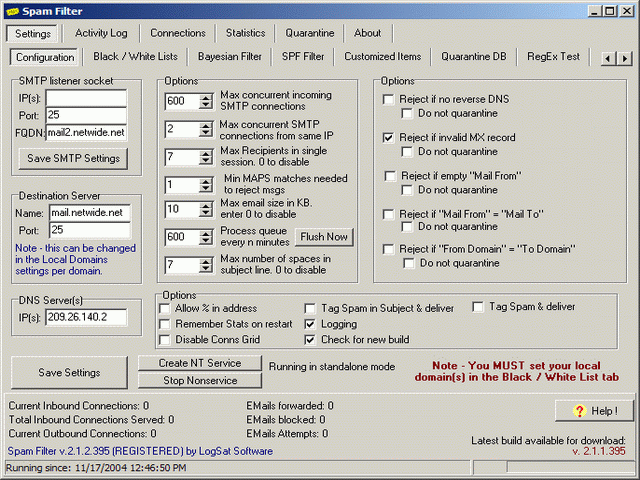
| Applets work with the Java program. Filters Internet filters is basically software where it blocks or stop its users by logging in to undesirable or permeable websites. For example, a blogger might have set up his/her blog to be only open for selected readers, thus those who are not invited are filtered and denied access to the weblog. Filters can be implemented in many ways; by software from a personal computer or provided by the internet access. Internet Service provider (ISP) blocks webpage that are objectionable to its users, like pornography or dangerous websites. While for search engine filters (Yahoo, Google e.g.) offers its users the security filter. Once activated, explicit contents for example will be automatically blocked from its user. |
 |
| ISP Filter. |
 |
| Google's web filter. |
 |
Internet Security Suite Internet Security Suite is basically security software installed to the computer to ensure security whilst online, making sure virus is detected. It is an anti-virus software which protects the computer from any sort of viruses or 'worm' which would affect the computer system. Among the top Internet security suites are Norton Internet Security, Kapersky Internet Security and F-Secure Internet Security.  FTP; File Transfer Protocol File Transfer protocol or FTP is a standard network protocol used to copy a file from one host to another, like the Internet. It is claimed to be faster than any other protocols, like the HTTP or POP in terms of exchanging files. It also helps in transferring data efficiently and reliably.  Wiki is a server which allows users create Web page using any browser, where they can actually edit their pages freely. It supports hyperlinks and has a simple text syntax that helps in creating new pages and crosslink in the webpage. It is also considered as an 'encyclopaedia' where many information are included in a single webpage with many interlinks in it, which causes that particular webpage to have some unnecessary materials considered as 'off-topic'.  URL Known as the Uniform Resource Locator, it is the global address of documents or other resources in The World Wide Web. The first part of the address is called the protocol identifier; indicates what protocol to use and the second part is called a resource name, where the domain name is used. the protocol identifier and the resource name are separated by a colon and two forward slashes.  |
 .
.